On this page
Palo Alto entered the 1980s as a settled suburb. Its population had stopped growing, its foothills were protected and its school district was shrinking. Yet the decade was busy. Engineers from Stanford and Xerox PARC left to start companies that would define personal computing. Downtown offices multiplied so fast that the city froze new building and then capped it. Residents fought to keep a skating rink, a garden and an old movie palace. And on October 17, 1989, an earthquake reminded everyone what lay under it all.
This page picks up where our 1970s page leaves off and runs to the end of 1989. It sticks to events with documented dates.
The personal computer era
The groundwork had been laid in the 1970s at Xerox PARC on Coyote Hill Road, where researchers built the Alto with its mouse, windows and networking. Steve Jobs saw it in December 1979. In the 1980s those ideas left the lab:
- 1982: John Warnock and Charles Geschke left PARC to found Adobe, building on PARC work in printing and page description. See our Xerox PARC page.
- February 24, 1982: Sun Microsystems was founded by Scott McNealy, Andy Bechtolsheim, Vinod Khosla and Bill Joy. The name came from the Stanford University Network, the campus project for which Bechtolsheim designed his workstation. Our Sun Microsystems page covers its later Palo Alto years.
- 1984: Apple's Macintosh brought the mouse to a mass market. HP introduced the ThinkJet printer, built on thermal inkjet technology from HP Labs in Palo Alto.
- 1985: Jobs left Apple and founded NeXT, a computer company aimed at universities and businesses.
- 1987: Sun licensed its SPARC processor design to chipmakers. Schlumberger sold Fairchild Semiconductor, once of Charleston Road, to National Semiconductor.
Older names were honored as the industry grew up. Bill Hewlett received the National Medal of Science in 1983 and Dave Packard the Presidential Medal of Freedom in 1988. The state registered the HP Garage as California Historical Landmark No. 976 in 1987 and dedicated it as the Birthplace of Silicon Valley in 1989. Doug Engelbart, inventor of the mouse, retired in 1986 and founded the Bootstrap Institute with his daughter Christina in 1988.
Downtown gets a growth cap
The new companies needed offices and many wanted to be downtown. A later city report describes "a period of rapid growth in the early 1980s" and worsening traffic. The city's response came in steps:
- 1984: The city launched a Downtown Study because of traffic.
- September 1984 to September 1986: A downtown moratorium held most new projects while the study went on.
- 1986: Ordinances capped new non-residential space downtown at 350,000 square feet beyond what existed or was approved in May 1986. Housing was left out on purpose, to encourage homes near jobs. New commercial space needed one parking space per 250 square feet.
- 1989: A Citywide Land Use and Transportation Study set a limit of just over 3.25 million square feet of new non-residential development across the city.
The cap shaped downtown for three decades. The ground floors kept their shops while offices filled the upper stories. The dot-com boom of the late 1990s would test it hard. In 1988 Saeed Amidi's family bought the office building at 165 University Avenue and began renting to young companies, setting up the address later called the lucky building. Our page on University Avenue's tech history tells that story.

Saving places
The 1980s were a decade of local rescue campaigns. Several of the city's best-loved places survive because of them:
- The Winter Lodge. Facing redevelopment, skaters formed the Friends of the Winter Club in 1981 and reopened the rink as the Winter Lodge in 1983. In November 1985 voters approved Measures A and B, which allowed a land swap so the rink could stay. See our Winter Lodge page.
- Gamble Garden. Elizabeth Gamble died in 1981 at 92 and left her home and garden to the city. In 1985 the council voted 8 to 1 for a garden plan and a nonprofit has run it as a public garden since. Our Gamble Garden page covers a visit.
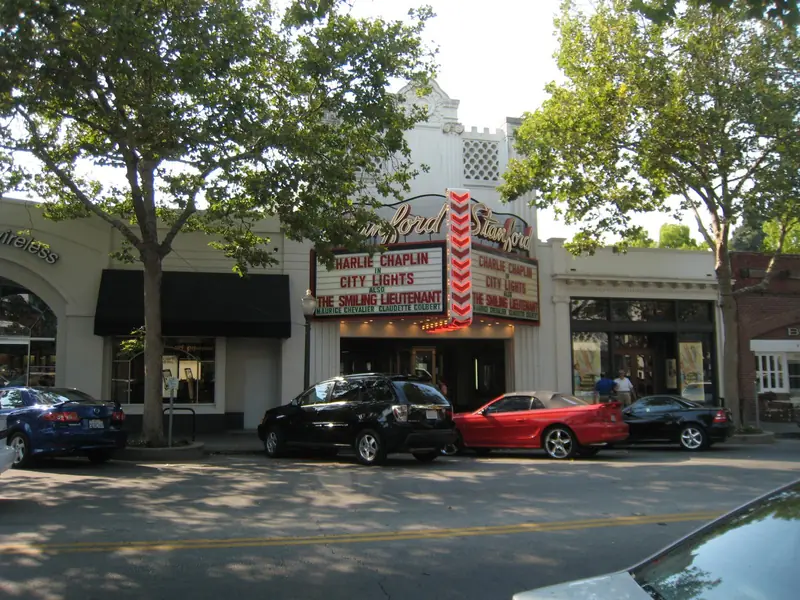
- The Stanford Theatre. In 1987, after Fred Astaire died, David Woodley Packard rented the 1925 movie palace for a run of Astaire films. The Packard Foundation bought it that year and reopened it in 1989 with The Wizard of Oz. See our Stanford Theatre page.
- The Hostess House. The Julia Morgan building near the train station became the MacArthur Park restaurant in 1981.
Formal preservation grew too. Professorville joined the National Register in October 1980. The Ramona Street Architectural District followed in March 1986. The state placed the Muybridge plaque at Stanford in April 1983 and dedicated the Sarah Wallis Mayfield Farm plaque in October 1986.
The bay and the bike
Two long debates were settled. At the Baylands, voters rejected more dredging of the old yacht harbor in 1980 and a boater-run plan in 1985. The City Council voted in 1986 to close the harbor and the boats left that year, letting the basin return to marsh. Our Baylands history page has the full story.
On land, Palo Alto built its reputation as a cycling city. Palo Alto Online dates the opening of the Bryant Street bike boulevard to 1982, though the city dates its first bike boulevard to the 1970s. Its champion was Ellen Fletcher, who served on the City Council from 1977 to 1989. Read more on our Ellen Fletcher page. On the rails, Caltrans took over the Peninsula commuter trains in 1980 and the service was renamed Caltrain in 1985.
Schools and neighbors
The school district kept shrinking. The old Mayfield grammar school was torn down in 1982. Jordan Middle School closed in 1985 and Wilbur merged into it under the name Jane Lathrop Stanford. Enrollment hit its low of 7,452 in 1989. In 1986 PAUSD began the Voluntary Transfer Program, known as Tinsley, which brings Ravenswood students to Palo Alto schools.
Next door, East Palo Alto voted to become a city by a margin of about a dozen votes. It incorporated on July 1, 1983, with Barbara A. Mouton as its first mayor. The state Supreme Court upheld the result in 1986. Our East Palo Alto page covers its story.
Stanford had its own milestones. The teams became the Cardinal, in the singular, on November 17, 1981. The Lane Lecture Series began the same year. The Rodin Sculpture Garden opened in 1985 and in 1986 the Packards gave $40 million toward a children's hospital at Stanford.
October 17, 1989
At 5:04 p.m. on October 17, 1989, as fans settled in for a Bay Area World Series game, the Loma Prieta earthquake struck. It measured magnitude 6.9 with an epicenter in the Santa Cruz Mountains about 35 miles from Palo Alto. The strongest shaking lasted about 15 seconds. Across the region 63 people died, most in the collapse of the Cypress Street Viaduct in Oakland.
Stanford took the worst local damage. Its studies counted 242 damaged buildings, 20 of which were closed. The repair bill came to about $160 million. Memorial Church stayed shut until November 1992 and the old museum did not reopen until 1999. No deaths or injuries were reported on campus. Our Loma Prieta page covers the quake and the long rebuild.
What the decade left
The decade also closed a chapter. Architect Birge Clark, who shaped downtown's Spanish Colonial look, died on April 30, 1989, at 96. What the 1980s added is easy to see: a downtown with office limits, a rink, a garden and a restored theater. The companies founded in the 1980s set up the boom that followed, which our dot-com era page picks up.
Frequently asked questions
What happened in Palo Alto in the 1980s?
Stanford and Xerox PARC spun off companies such as Sun Microsystems and Adobe in 1982. The city studied downtown traffic from 1984 and capped new downtown commercial space in 1986. Residents saved the Winter Lodge rink and the Stanford Theatre was restored. The decade ended with the Loma Prieta earthquake in October 1989.
What was the Palo Alto downtown cap?
Adopted in 1986 after a two-year downtown study and moratorium, it limited new non-residential space downtown to 350,000 square feet beyond what existed or was approved in May 1986. Housing was excluded to encourage homes near jobs. A 1989 citywide study then set a limit of just over 3.25 million square feet across the city.
When was the Stanford Theatre restored?
The David and Lucile Packard Foundation bought the 1925 movie palace on University Avenue in 1987 after David Woodley Packard ran a Fred Astaire festival there. It reopened in 1989 after a careful restoration and still shows classic films.
How did the 1989 earthquake affect Palo Alto?
The Loma Prieta earthquake struck at 5:04 p.m. on October 17, 1989, with magnitude 6.9 and an epicenter about 35 miles away. Stanford counted 242 damaged buildings and a repair bill of about $160 million. Memorial Church stayed closed until November 1992.
Was Palo Alto growing in the 1980s?
Not much in population. The census counted 56,040 residents in 1970 and 55,225 in 1980 and the city had little room left to build. Commercial growth was another matter: a city report describes rapid growth in the early 1980s that led to the downtown cap.