On this page
Every town has its bragging points. Palo Alto's are unusually specific, because so many of them sit on state plaques, city records and engineering milestones. Still, "first" is a slippery word. Some claims are carved in bronze by the state. Some come from the institution itself. A few are "one of the first," which is not the same thing at all.
This page lists the Palo Alto firsts we could tie to a named source, roughly in date order. For each one it says who makes the claim. Most sit inside city limits. A few are on Stanford land next door, which we note. For the wider story in order, see our Palo Alto timeline.
At a glance
| Year | First | Who says so |
|---|---|---|
| 1878 | Muybridge's motion photographs at the Stock Farm | State landmark No. 834 (Stanford land) |
| 1896 to 1917 | A full set of city-owned utilities | Institute for Local Government |
| 1911 to 1913 | Vacuum tube amplifier and oscillator | State landmark No. 836 |
| 1919 | First municipally sponsored community center in the nation | State plaque, landmark No. 895 |
| 1940 | Oldest freestanding children's library in the U.S. | Palo Alto City Library |
| 1951 | First university research park | Widely described; Stanford land |
| 1959 | First commercially practicable integrated circuit | State landmark No. 1000 |
| 1970s or 1982 | First bicycle boulevard in the U.S. | City of Palo Alto |
| 1978 | Among the first curbside recycling programs | Institute for Local Government |
| 2013 and 2017 | First utility with carbon-neutral electricity and gas as standard | City of Palo Alto |
Early firsts: photographs and public utilities
Motion photography, 1878
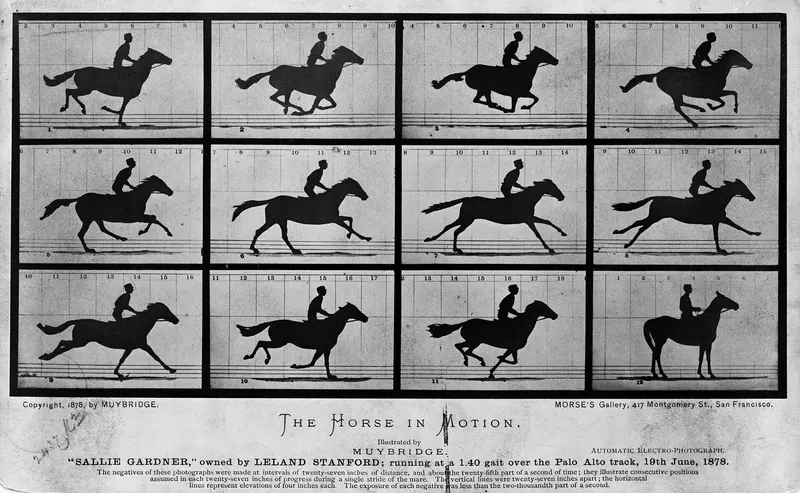
On June 15, 1878, Eadweard Muybridge photographed a trotter with a row of 12 cameras on the track of Leland Stanford's Palo Alto Stock Farm. The sequence proved that a trotting horse lifts all four hooves off the ground at once. California Historical Landmark No. 834, on Campus Drive West, honors the work as part of the development of motion pictures. The site is on Stanford land, just outside city limits.

City-owned utilities, 1896 onward
The young city built its own services fast: water in 1896, sewers in 1898, electricity on January 16, 1900 and gas in 1917. The Institute for Local Government calls Palo Alto the first and only municipality in California that operates a full suite of city-owned utility services. That is an outside group's description rather than a legal ranking, but no other California city has been named as a rival. Our city utilities history tells how it happened.
Electronics firsts
The vacuum tube amplifier, 1911 to 1913
The state plaque at the corner of Channing Avenue and Emerson Street says that here Lee de Forest "devised the first vacuum tube amplifier and oscillator" while working for Federal Telegraph. It is California Historical Landmark No. 836, registered in 1969. Federal Telegraph itself is often called the first sizable electronics company in the area. See our Federal Telegraph page.
The integrated circuit, 1959
After leaving Shockley's lab in 1957, the eight founders of Fairchild Semiconductor moved to 844 East Charleston Road in Palo Alto. California Historical Landmark No. 1000 marks the site as that of the first commercially practicable integrated circuit. Robert Noyce filed his patent in July 1959. The full story is on our Shockley and semiconductors page.
The personal computer, 1973
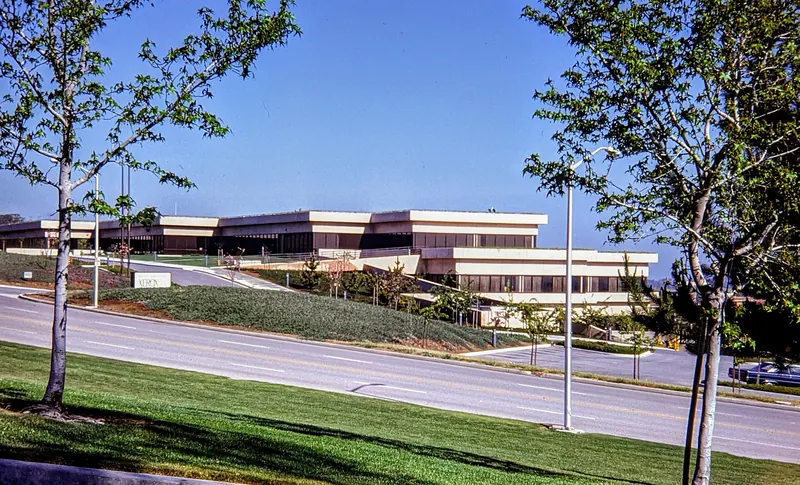
Xerox PARC, in Stanford Research Park, introduced the Alto on March 1, 1973. With its mouse, windows and networked printing, it is widely considered the first modern personal computer, though it was never sold to the public in large numbers. Our Xerox PARC profile covers the lab.

Civic firsts
The first city community center, 1919
Julia Morgan designed the Hostess House in 1918 for Camp Fremont in Menlo Park. After World War I, Palo Alto bought the building, cut it into pieces and moved it across San Francisquito Creek. Its state plaque says it became the first municipally sponsored community center in the nation. It was dedicated on November 11, 1919. Read more on our Hostess House page.
The Children's Library, 1940
The Children's Library on Harriet Street opened in 1940 as a gift of Lucie Stern. The Palo Alto City Library describes it as the oldest freestanding children's library in the United States and the first freestanding library built solely for children. A 2025 library blog post goes further and calls it the first freestanding library in the country intended only for children. See our Children's Library history.
A theater for children
The Palo Alto Children's Theatre was founded in 1932 by Hazel Glaister Robertson. The theater says a 1937 gift from Lucie Stern made it one of the first children's theaters in the nation to have a fully equipped theater just for young people. Our Children's Theatre page covers today's shows.
The first university research park, 1951
In 1951 Stanford and the city created the Stanford Industrial Park off Page Mill Road, now Stanford Research Park. It is commonly described as the first university research park in the world. Varian Associates moved into its first building in 1953 and Hewlett-Packard, Xerox PARC and many others followed. The land is Stanford's, but most of the park lies inside Palo Alto city limits. See our Stanford Research Park guide.
Nearby on Stanford land, two medical and digital firsts are worth knowing. In 1968 Norman Shumway's team at Stanford performed the first successful adult human heart transplant in the United States. In December 1991 SLAC put the first web server outside Europe online.
The first bicycle boulevard
The city calls Bryant Street "the first Bicycle Boulevard implemented in the United States." A bicycle boulevard is a quiet street where barriers and signs keep through car traffic low and give bikes priority. Sources disagree on the start date. The city's project page dates the first boulevard to the 1970s, while Palo Alto Online dates its opening to 1982. Council member Ellen Fletcher championed it. Our Ellen Fletcher page tells her story.
Environmental firsts
- Curbside recycling, 1978. The Institute for Local Government says Palo Alto was one of the first cities to begin a curbside recycling collection program, in 1978. Note the wording: among the first, not the first.
- Fiber to the home, 1999. On April 5, 1999, the City Council voted 7 to 1 for a five-year fiber-to-the-home trial in the Community Center neighborhood, one of the earliest such trials in an established American city.
- Green power, 2003. The city introduced its PaloAltoGreen renewable electricity option in 2003.
- Climate plan, 2007. The city was one of the first in California to adopt a climate action plan, in 2007.
- Carbon-neutral energy, 2013 and 2017. The city says it has provided 100 percent carbon neutral electricity since 2013 and carbon neutral natural gas since July 1, 2017. It calls itself the first utility in the world to provide both as a standard to all customers.
For today's trash and compost rules, see our trash and recycling guide.
How to read a "first"
Three questions help sort these claims. First, who is making it: a state plaque, an independent body or the institution itself? Second, what exactly is being counted? The Children's Library claim depends on the word freestanding and the Hostess House claim depends on municipally sponsored. Third, where is it? The Muybridge photographs, the heart transplant and SLAC's web server all happened on Stanford land, which is not part of the City of Palo Alto even though it shares the name in everyday speech. Keeping those distinctions straight makes the real firsts more impressive, not less. To see several of these sites in one day, book a Silicon Valley history tour.
Frequently asked questions
What was invented in Palo Alto?
Several milestones are tied to Palo Alto addresses. Lee de Forest developed the vacuum tube amplifier and oscillator at Federal Telegraph from 1911 to 1913, Hewlett-Packard began in a garage on Addison Avenue in 1939 and Fairchild Semiconductor's work on the first commercially practicable integrated circuit is marked at 844 East Charleston Road. Xerox PARC's Alto, often called the first modern personal computer, came out of Palo Alto in 1973.
Is the Palo Alto Children's Library the first in the country?
The Palo Alto City Library describes the 1940 Children's Library as the oldest freestanding children's library in the United States and the first freestanding library built solely for children. That is the library's own claim and it is widely repeated.
Did Palo Alto have the first bike boulevard?
The city calls Bryant Street the first bicycle boulevard implemented in the United States. The city dates it to the 1970s, while Palo Alto Online dates the opening to 1982.
When did Palo Alto start curbside recycling?
The Institute for Local Government says Palo Alto was one of the first cities to begin a curbside recycling collection program, in 1978. It does not claim it was the very first.
Is Palo Alto's electricity carbon neutral?
Yes. The city says it has provided 100 percent carbon neutral electricity since 2013 and carbon neutral natural gas since July 1, 2017. It calls itself the first utility in the world to offer both as a standard to all customers.