On this page
Palo Alto means tall stick or tall tree in Spanish and the city has never let anyone forget it. The redwood called El Palo Alto, beside San Francisquito Creek at Alma Street, appears on the city seal, the city logo and the flag. Stanford put the same tree on its own seal more than a century ago. Few towns lean so heavily on a single living thing for their identity.
This page explains each official emblem: what the municipal code says about the seal and logo, how the flag came about, the meaning its designer gave its colors and the civic flagpole that earned a state listing. It also flags one puzzle, the incorporation date printed on the seal. Sources include the Palo Alto Municipal Code, the Flags of the World archive, Wikipedia and the state's historical registers.
The city seal
The seal is defined in law. Section 2.06.010 of the Palo Alto Municipal Code, titled The City Seal and City Logo, was last set by Ordinance 5204 in 2013. It describes the seal this way, paraphrased lightly:
- Three concentric circles, with the outermost the broadest and shaded inside.
- The words City of Palo Alto California in capital letters between the outer circle and the second.
- The words Incorporated April 23, 1894 between the second and third circles.
- A green tree in the center.
A description posted to the Flags of the World archive, based on an older version of the city's website, adds detail the code leaves out. It describes a gold background, blue block lettering with City of Palo Alto at the top and California at the bottom, two small five-pointed stars at the sides and a redwood at the center. The code governs, so treat those colors as how one version of the seal has been drawn rather than a legal requirement.
The April 23 puzzle
The date on the seal does not match the dates most histories give. A 2018 City Council resolution lays out the incorporation steps: male residents voted 98 to 21 for incorporation on April 9, 1894; the results were filed with the state on April 16; the state approved on April 21. This site, like most local histories, uses April 16. The council made April 9 Palo Alto Day. The seal's April 23 fits none of them. It may reflect a later recording step or an old error that was copied forward. We found no source that explains it. Our page on the founding of Palo Alto covers the incorporation in detail.
The city logo
The same code section defines a simpler city logo. It has two concentric circles. The outer ring is broad and solid green. The inner circle is shaded green with a white tree in the center. The words City of Palo Alto appear below the circles or to their right. The code also lets the City Manager approve other logos, which must be kept on file.
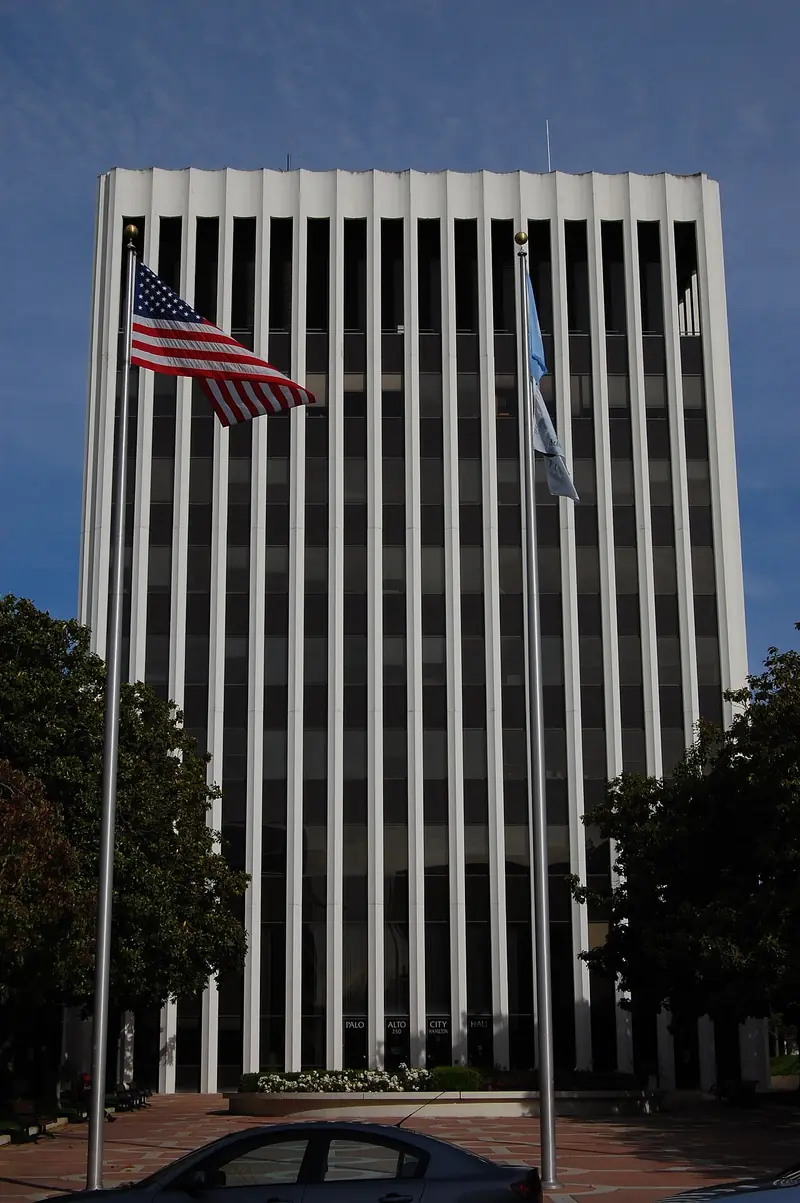

The city flag
Palo Alto's flag is a 1960s creation. In a 2005 note to the Flags of the World archive, Steve Staiger, then the city's historian, wrote that the flag was designed by a city employee named Christa Gupton and officially adopted by the City Council in 1967. It places the city seal on a middle band with a band of blue and a band of green on either side.
In 2009 the designer, writing as Christa Kaufmann, added her own account to the same archive. She wrote that she was a receptionist and assistant at City Hall while George Morgan was city manager, that the city had no flag and that she designed it, bought the fabric and sewed it by hand. She recalled that the press called her the Betsy Ross of Palo Alto. She gave each color a meaning:
| Color | Meaning, per the designer |
|---|---|
| Green | The abundance of trees in the city |
| White | The city's bright future |
| Blue | The good weather and climate |
| Gold | The wealth of education available to residents |
The council's 1967 action is documented through the city historian's note. The color meanings come from the designer's recollection, not an ordinance, so present them that way if you quote them.
The civic flagpole
Before the city had a flag, it had a famous flagpole. A 1969 city marker on University Circle, near the Caltrain station, says a 205-foot flagpole was dedicated on The Circle in 1908 by the Native Sons of the Golden West and later moved to the site of the Hostess House. The state registered the spot on November 3, 1969, as a California Point of Historical Interest under the name First Community Center and Palo Alto City Flag Pole. Our historic markers guide tells you where to read the plaque and our Hostess House page covers the building.
El Palo Alto as a symbol
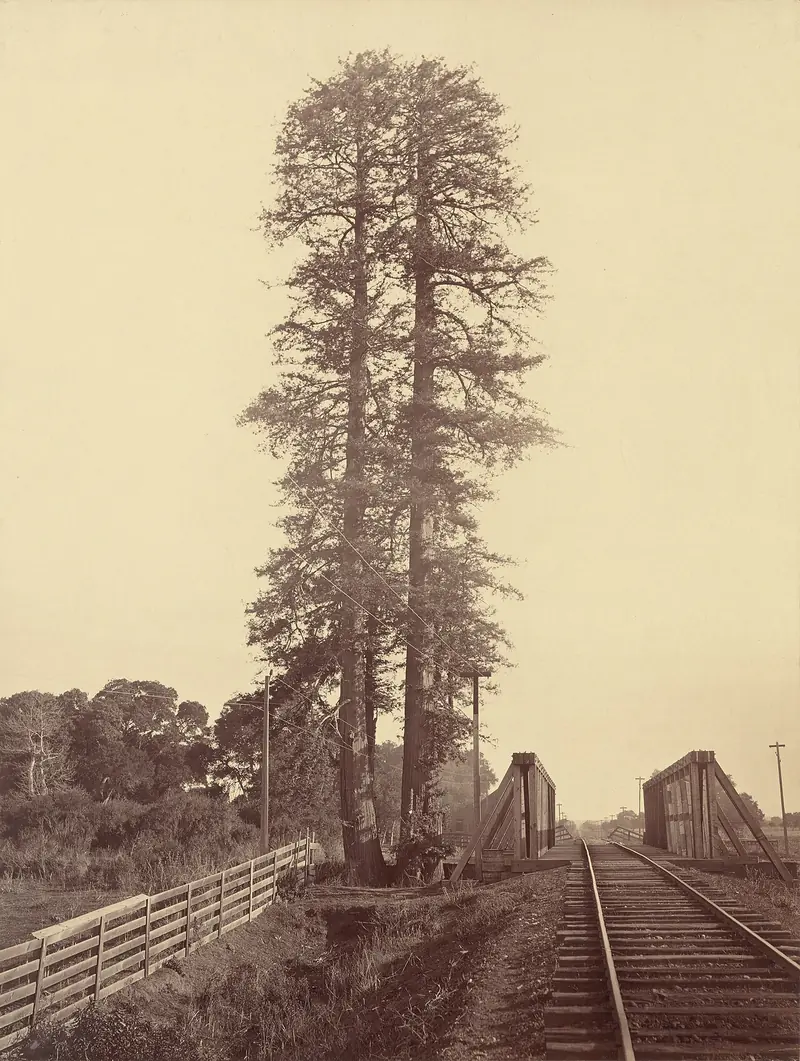
The tree behind all of these emblems is a coast redwood that sprouted around A.D. 940, based on ring counts and age estimates. Members of the Portolá expedition camped near it in November 1769 and named it El Palo Alto. It once had a twin trunk, photographed by Carleton Watkins in 1870, that fell sometime between about 1875 and the 1880s. Today the remaining trunk stands about 110 feet tall.

The tree carries several official titles:
- California Point of Historical Interest, registered March 15, 1974.
- Heritage Tree No. 1 on the city's heritage tree list.
- Recognized in 1987 by the National Arborist Association and the International Society of Arboriculture for its historical importance.
The nearby camp site is California Historical Landmark No. 2, registered in 1932, with its plaque on the Menlo Park bank. A 1926 plaque from the Native Sons of the Golden West sits in a boulder beneath the tree. Visit El Palo Alto Park at Alma Street and Palo Alto Avenue. Our El Palo Alto page has visiting tips and our heritage trees page explains the city's tree list.
The tree at Stanford
Stanford adopted a university seal featuring the redwood in 1908. The tree also inspired the Stanford Tree, the costumed mascot of the Stanford marching band. Officially Stanford's teams are the Cardinal, named for a color rather than a bird. The university has no official mascot, so the Tree is a band tradition. Our page on the Cardinal name and the Tree explains the difference.
One irony: El Palo Alto stands on the city side of San Francisquito Creek, east of the railroad, so it was never on Stanford land. Southern Pacific owned the ground for decades and leased it first to the Native Sons and later to the city. It became a city park in 1971.
Other civic symbols
A few more emblems round out the picture:
- Palo Alto Day. In 2018 the City Council named April 9, the date of the 1894 incorporation vote, Palo Alto Day.
- Tree City USA. The city has held Tree City USA status since the late 1980s, a fitting badge for a place named after a tree. Our urban forest guide covers the program.
- No official bird, flower or motto. The code section that defines the seal and logo names none and we found no other ordinance that does. If one exists in an older resolution, it is not in common use.
To see the real tree with a guide, a Stanford and Palo Alto tour usually starts or ends nearby.
Frequently asked questions
What is on the Palo Alto city seal?
The municipal code describes three concentric circles with the words City of Palo Alto California between the outer rings, the words Incorporated April 23, 1894 in the next ring and a green tree in the center. The tree stands for El Palo Alto, the redwood that gave the city its name.
Does Palo Alto have a city flag?
Yes. According to a 2005 note by city historian Steve Staiger, the flag was designed by a city employee and adopted by the City Council in 1967. It carries the city seal on a middle band with bands of blue and green on either side.
What do the colors of the Palo Alto flag mean?
The flag's designer has written that green stands for the city's many trees, white for its bright future, blue for its good weather and gold for the wealth of education available to residents. That explanation comes from her own account rather than a city document.
Why does the seal say April 23, 1894?
That is the date written into the municipal code's description of the seal. Other city records give April 9 for the incorporation vote, April 16 for the filing of results and April 21 for state approval. We found no explanation for the April 23 date.
Is El Palo Alto on Stanford's seal too?
Yes. The redwood appears on the Stanford University seal, first adopted in 1908. The Stanford Tree mascot of the marching band is a nod to it as well. The tree itself stands on the Palo Alto side of San Francisquito Creek, never on Stanford land.