On this page
Sacramento and Palo Alto are linked by state politics, university ties and a long commute corridor. Lawmakers, lobbyists, Stanford researchers and students all make the trip. There is no single fast way to do it. The train needs a change in San Jose and the drive crosses several of the region's busiest interchanges. Both work well once you know the timing.
This page covers the trip from Sacramento, Davis and the rest of the Sacramento area. If you are heading the other way for a day at the Capitol, see our Sacramento day trip. For trips from Oakland or Berkeley, our guide to getting here from the East Bay is a better fit.
The options at a glance
| Option | Rough time | Best for |
|---|---|---|
| Drive via I-80 and I-680 | 2 to 2.5 hours | Most trips, groups, flexible times |
| Capitol Corridor plus Caltrain | About 4 hours with the transfer | Working on the way, no parking worries |
| Capitol Corridor plus VTA bus | Longer than Caltrain | A backup when the train times do not line up |
The Capitol Corridor to San Jose
The Capitol Corridor is the Amtrak-run train between Auburn, Sacramento and San Jose. From Sacramento Valley Station it heads west through Davis, Suisun-Fairfield and Martinez, then down the East Bay through Richmond, Berkeley, Emeryville, Oakland, Hayward, Fremont and Santa Clara to San Jose Diridon.
Which trains go through
Most Capitol Corridor trains end in Oakland. On the timetable effective December 8, 2025, seven westbound trains a day continued to San Jose on weekdays, from a 4:20 a.m. departure out of Sacramento to an early evening one. Weekends also had seven. The early train reached San Jose about 3 hours 10 minutes after leaving Sacramento. Read the train's final stop on the timetable before you buy, or you may find yourself changing in Oakland.
Tickets and ID
Buy tickets from the Capitol Corridor site, the Amtrak app or the station machines. The operator says a valid government-issued photo ID is required to board all its trains and connecting buses. The operator also advertises a companion deal: buy one full fare and save 50 percent on up to five companion fares. Cats and dogs under 20 pounds can ride for $29 one way.
Bikes on board
Each train has two bike cars, each holding about a dozen bikes, plus three bike racks on the lower level of every car. Folding bikes count as baggage. Our guide to arriving by bike covers the Caltrain side of the trip.
Service changes in late 2026
Two notices on the Capitol Corridor site matter for this trip. Check both before you travel.
- Oakland Coliseum. From October 26, 2026 to January 1, 2027, trains 521, 547 and 550 on weekdays and 746, 747 and 748 on weekends do not stop at Oakland Coliseum because of insufficient lighting at the station. Other stations are not affected. Conductors honor tickets at adjacent stations. The operator suggests changing to BART at Richmond instead. See the disruption notice for the modified schedule.
- San Jose Diridon. From October 19 through December 2026, Caltrain is repairing concrete and flooring at Diridon. Work may close platforms, ramps or stairs for a time, without affecting elevators. Expect delays of up to five minutes and follow the track assignment signs.
Most riders from Sacramento to Palo Alto stay on the train past the Coliseum anyway. The change matters if you planned to switch to BART there.
The Caltrain connection
At Diridon, walk to the Caltrain platform and catch a northbound train. Express trains reached Palo Alto in about 21 minutes on the late October 2026 weekday timetable, while limited and local trains took about 27. Diridon is in Zone 4 and Palo Alto in Zone 3, so the ride is two zones: $6.25 for an adult in October 2026 and $6.50 from January 1, 2027. Tap a Clipper card, a contactless bank card or a phone wallet on the validator before you board.
The Capitol Corridor also stops at Santa Clara University, next to Santa Clara's Caltrain station. Changing there can save a few minutes, but check that your Caltrain stops at Santa Clara before you rely on it. On weekends Caltrain runs locals about every 30 minutes, so a missed connection costs you half an hour. Our Caltrain guide covers fares and train types.
The VTA backup
According to the Capitol Corridor's San Jose station page, VTA accepts its transit transfers. VTA Route 22 and Rapid 522 run from downtown San Jose, a few blocks from Diridon, along El Camino Real to the Palo Alto Transit Center. They are much slower than Caltrain but useful late in the evening. Our page on VTA buses explains the routes.

Driving from Sacramento
Expect about 120 miles of driving. Plan on two to two and a half hours without bad traffic.
Route 1: I-80 and I-680
Take Interstate 80 west past Davis and Vacaville. At Cordelia, near Fairfield, bear left onto Interstate 680 south. It crosses the Benicia-Martinez Bridge, then runs through Walnut Creek, San Ramon, Dublin and the Sunol Grade to Fremont. From there you have two choices:
- Over the Dumbarton Bridge. Take State Route 84 west across the bay into Menlo Park, then follow University Avenue or Willow Road into Palo Alto. The bridge charges a westbound toll, $8.50 for a car in 2026. It lands next to East Palo Alto.
- Around the south end of the bay. Stay on Interstate 880 south to State Route 237, then take US 101 north. It is a little longer but avoids bridge tolls.
Route 2: the Altamont
From south Sacramento or Elk Grove, some drivers prefer Interstate 5 south, then Interstate 205 and Interstate 580 over the Altamont Pass to join I-680 at Dublin. It avoids I-80 but runs into heavy commute traffic on the Altamont. Live traffic apps settle which route is faster on the day.
Traffic to plan around
- I-80 near Vacaville and Fairfield fills with Tahoe traffic on Friday afternoons and Sunday evenings.
- I-680 over the Sunol Grade and the Dumbarton Bridge westbound are slow on weekday mornings.
- Bay Area bridges take no cash. Tolls go to FasTrak or a mailed invoice, so ask a rental company how it bills them.
Our driving guide lists the Palo Alto exits and parking rules. If you need a car for the trip, you can compare rental cars in Sacramento before you go.
Buses
Intercity coaches run between Sacramento and the Bay Area, but none is listed with a stop in Palo Alto. If a coach serves San Jose Diridon, the same Caltrain connection applies. Our intercity bus guide explains the stops. The Capitol Corridor also sells Thruway bus connections from places it does not reach. You can compare train and bus tickets across operators.
Good to know
- San Jose Diridon carries the station code SJC on Capitol Corridor tickets, the same three letters as the airport. Do not mix them up.
- The Capitol Corridor timetable lists the San Jose station as open from 6:15 a.m. to 10 p.m.
- A regional transit funding measure is on the November 3, 2026 ballot. Caltrain has warned of cuts without it, so check the timetable after the election.
When you arrive
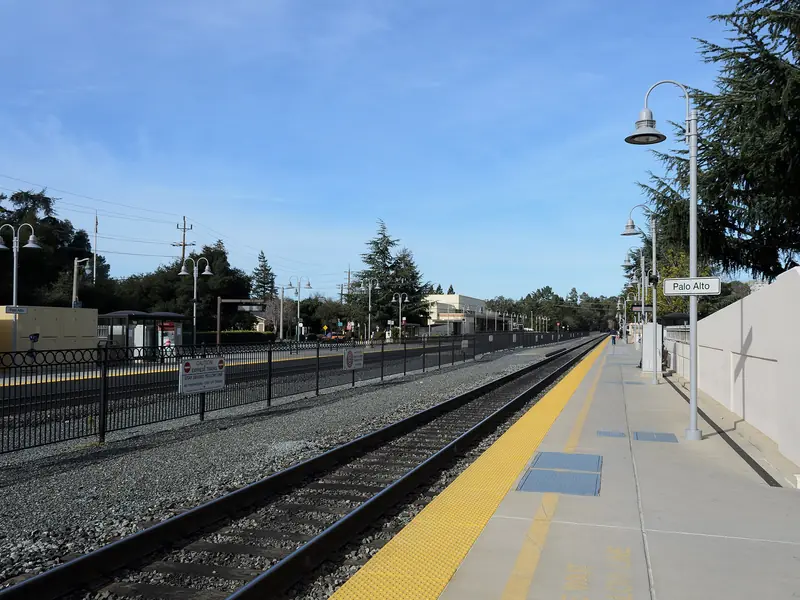
Caltrain leaves you at Palo Alto station, at the foot of University Avenue, with downtown on one side and Stanford on the other. If you need a bed close to the platform, compare hotels near Palo Alto station.
Frequently asked questions
Is there a train from Sacramento to Palo Alto?
Not a direct one. Ride the Capitol Corridor from Sacramento Valley Station to San Jose Diridon, then take a northbound Caltrain to Palo Alto. The Capitol Corridor leg takes a little over three hours and the Caltrain express about 21 minutes.
How many Capitol Corridor trains go all the way to San Jose?
On the timetable effective December 8, 2025, seven westbound trains a day ran through to San Jose on weekdays and seven on weekends. Other trains end at Oakland Jack London Square, so check the destination before you board.
What is the Oakland Coliseum service disruption?
From October 26, 2026 to January 1, 2027, Capitol Corridor trains 521, 547 and 550 on weekdays and 746, 747 and 748 on weekends skip Oakland Coliseum station because of lighting problems. Conductors honor tickets at nearby stations and the operator suggests changing to BART at Richmond instead.
How long does it take to drive from Sacramento to Palo Alto?
About two to two and a half hours for roughly 120 miles in normal traffic. Weekday commute hours on Interstate 680 and the Dumbarton Bridge can add an hour or more, as can Friday and Sunday traffic on Interstate 80.
Do I need ID to ride the Capitol Corridor?
Yes. The Capitol Corridor says a valid government-issued photo ID is required on all its trains and connecting buses. Keep it handy for the conductor.