On this page
San Francisco is 35 miles up the Peninsula from Palo Alto. Thousands of residents make the trip every workday. The good news is that Palo Alto has one of the best train connections on the line. The bad news is that the drive can be slow and parking in the city is expensive. This guide compares the options for someone living in Palo Alto, then flips the trip around for San Francisco residents who work here.
Times below come from the weekday timetable on Caltrain's schedules page in early November 2026. Fares come from the Caltrain fares page. Drive times are rough guides only. For tickets and train types in more depth, read our Caltrain guide.
Caltrain: the default choice
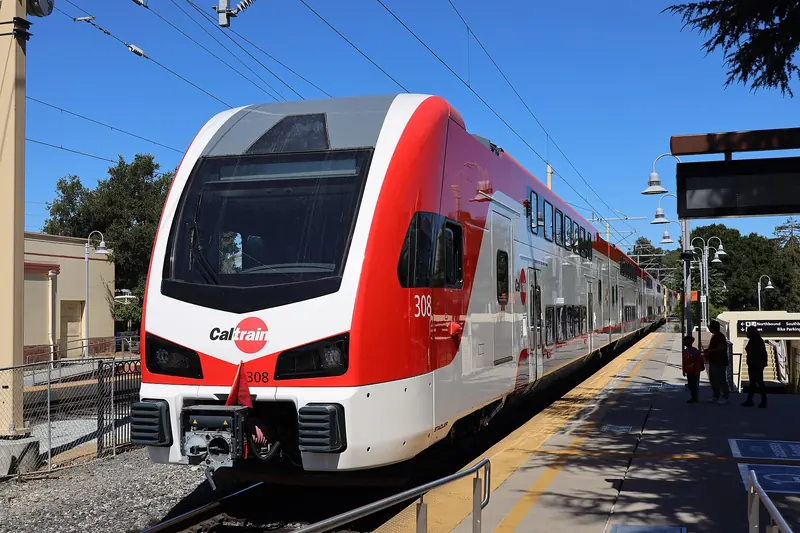
Most Palo Alto commuters to the city ride Caltrain. Trains leave from Palo Alto station at the foot of University Avenue and from California Avenue station in Midtown. They arrive at the San Francisco terminal at Fourth and King streets, with a stop at 22nd Street in Dogpatch on the way.
| Train type | From Palo Alto | From California Avenue | When it runs |
|---|---|---|---|
| Express (500s) | 39 minutes | Does not stop | Weekday peaks only |
| Limited (400s) | 41 to 43 minutes | 44 to 46 minutes | Weekday peaks only |
| Local (100s) | 49 to 51 minutes | 52 to 54 minutes | All day, twice an hour |
| Weekend local (600s) | About 51 to 52 minutes | About 54 to 55 minutes | Saturday and Sunday |
Peak hour pattern
The timetable repeats at the same minutes each hour. In the morning, northbound express trains left Palo Alto at 6:43, 7:43 and 8:43 a.m. Limited trains left at 10 minutes past the hour from 6:10 to 9:10 a.m. Locals ran at 25 and 55 minutes past. That adds up to four trains an hour from Palo Alto in the busiest hours.
Going home, express trains left San Francisco at 3:20, 4:20, 5:20 and 6:20 p.m. and reached Palo Alto 39 minutes later. Midday and late evening service drops to two locals an hour. The first weekday train left Palo Alto at 5:10 a.m. The last southbound train left San Francisco at 12:05 a.m.
Fares for 2026 and 2027
Palo Alto and California Avenue are in Zone 3 and San Francisco is in Zone 1, so the trip counts as three zones. The Caltrain board approved new fares on November 6, 2025. These adult prices apply from January 1, 2027:
| Ticket, 3 zones | Through December 31, 2026 | From January 1, 2027 |
|---|---|---|
| Adult one way | $8.50 | $9.00 |
| Adult day pass | $17.00 | $18.00 |
| Adult monthly pass | $204 | $216 |
| Eligible Discount one way | $4.00 | $4.50 |
| Youth one way | $1.00 | $1.00 |
A monthly pass pays off at about 12 round trips a month at 2027 prices. It also covers unlimited weekend and holiday rides across every zone, except Christmas Eve. From January 1, 2027, monthly pass holders must tap on and tap off for every ride. Clipper cards and contactless bank cards pay the same fare. Our Clipper and fares guide explains discount cards and the transfer credit between agencies.

Getting to the station and beyond Fourth and King
The first and last mile decide whether the train works for you. Downtown and Professorville residents can walk to Palo Alto station. Midtown and Ventura are closer to California Avenue, but that station has no express trains. Some commuters ride a bike to Palo Alto station to catch the express instead.
Caltrain lots charge $5.50 a day, paid at a ticket machine or through the ParkMobile app. A monthly parking permit costs $82.50 and is sold only to monthly pass or GoPass holders. Caltrain says parking fees will not change on January 1, 2027.
The San Francisco terminal sits in SoMa, about a mile from the Financial District. Muni's light rail lines stop outside, including the T Third line through the Central Subway to Union Square and Chinatown. Many commuters walk or ride a bike the rest of the way. Caltrain does not yet reach the Salesforce Transit Center.
Bikes on the train
A bike solves both ends of the trip, which is why Caltrain's bike cars fill up at rush hour. The rules on Caltrain's bikes on the train page:
- Each electric train has two bike cars, each limited to 36 bikes. There is no extra charge.
- Riders with bikes board the bike car first and stack bikes by destination. Display a destination tag.
- Each bike must fit the 71 inch stall. Gas-powered, tandem and three-wheel bikes are not allowed.
- Folding bikes up to 32 inches wide can ride in any car if folded and stowed.
- Conductors can turn bikes away when a train is crowded.
Caltrain also says it has paused enforcement of its rules on bike attachments while it reviews its bike policy. To leave a bike at the Palo Alto end, Caltrain eLockers cost 5 cents an hour, or 2 cents at night and on weekends. Our bike parking guide covers racks and lockers at both Palo Alto stations.
Buses
Buses are slower than the train for this trip, but they fill gaps. SamTrans route ECR runs from the Palo Alto Transit Center up El Camino Real to Daly City BART, where BART continues into the city. It stops often, so treat it as a backup or a late night option. SamTrans Route 397 is the overnight bus between San Francisco and Palo Alto when trains are not running.
SamTrans also runs the EPX, a weekday bus from Bayshore Road at Donohoe Street in East Palo Alto via Redwood City Transit Center, SFO and San Bruno BART to the Salesforce Transit Center. Its August 2, 2026 timetable shows about an hour and a half from end to end, with an adult cash fare of $2.25. It suits riders near the 101 side of town more than downtown residents.
Driving to the city
The two routes are US 101 along the bay and Interstate 280 through the foothills. Both run about 35 miles to downtown San Francisco. With light traffic either takes roughly 40 to 50 minutes. At peak times an hour or more is common and a single crash can add much more.
- US 101 is the most direct road to SoMa and the Financial District. Northbound traffic is heaviest in the morning and southbound in the evening, but Palo Alto sits in a two-way commute zone, so expect slowing in both directions.
- Interstate 280 is usually less congested and much prettier. It reaches the western and southern neighborhoods of the city easily, then merges into heavier traffic near Daly City and the 101 interchange.
Express lanes and tolls
US 101 has express lanes from Mountain View to the Interstate 380 interchange in South San Francisco. The Santa Clara County segment runs from State Route 237 to Embarcadero Road. The San Mateo County segment runs from the county line to I-380. Both charge tolls Monday to Friday from 5 a.m. to 8 p.m. in both directions, according to FasTrak. Solo drivers pay the posted toll, which changes with traffic. Two-person carpools get 50 percent off and carpools of three or more ride free, but only with a FasTrak Flex tag set to match. The two segments bill separately. North of I-380 there are no express lanes. Interstate 280 has none at all. Our express lanes guide covers the details.
There is no bridge toll on the Peninsula route into San Francisco. If you need a car only now and then, you can compare rental car prices for the days you drive.
Parking in San Francisco
Parking is the hidden cost of driving. As one published example, the city-run Fifth and Mission Yerba Buena Garage, a short walk from Fourth and King and Union Square, listed these rates on its SFMTA page in late 2026:
- $6.00 an hour from 9 a.m. to 6 p.m.
- $38 for up to 12 hours and $44 for 24 hours.
- $350 a month for regular monthly parking, or $175 for a carpool or car share.
Special event rates of $8 to $58 can replace hourly prices when there is a game or a big event. Private garages in the Financial District often charge more. A monthly Caltrain pass at $216 in 2027 costs less than a monthly garage space before you count fuel or tolls.
Company shuttles
Some employers in the city run private commuter coaches down the Peninsula for their own staff. Some Palo Alto companies run coaches north for San Francisco residents. Routes and stops are internal, so this guide does not list them. Ask your employer's commute or facilities team. Many employers also provide Caltrain GoPass, a pass bought by the company for its workers, or pretax transit benefits that cover a monthly pass.
The reverse commute: San Francisco to Palo Alto
Working in Palo Alto and living in the city is common. The train serves it well because Caltrain runs express trains in both directions in both peaks. On the early November 2026 timetable, morning express trains left San Francisco at 6:20, 7:20 and 8:20 a.m. and reached Palo Alto at 6:59, 7:59 and 8:59 a.m. Evening northbound express trains left Palo Alto at 3:43, 4:43, 5:43 and 6:43 p.m.
From Palo Alto station, Stanford's free Marguerite shuttle reaches the campus, the medical center and Stanford Research Park on weekdays. See our Marguerite guide. Morning traffic on 101 runs heavily in both directions. The exits into Palo Alto slow down at peak times. Visitors coming down for a day can read our guide to getting here from San Francisco.
Good to know
- Caltrain weekends are local only, about every 30 minutes. Monthly pass holders ride those trains free.
- Caltrain runs a weekend schedule on Thanksgiving, November 26, 2026. A modified schedule runs the next day.
- A regional transit funding measure goes to voters on November 3, 2026. Caltrain has warned of service cuts without new funding, so recheck the timetable in 2027.
- Forgot to tap off? Caltrain charges the maximum fare from your starting station.
Frequently asked questions
How long is the Caltrain commute from Palo Alto to San Francisco?
On the weekday timetable Caltrain posted in early November 2026, express trains took 39 minutes from Palo Alto to San Francisco. Limited trains took 41 to 43 minutes and locals about 49 to 51. Express trains run only in the morning and evening peaks.
How much does a monthly Caltrain pass from Palo Alto to San Francisco cost?
Palo Alto to San Francisco is a three zone trip. The adult monthly pass costs $204 through December 2026 and $216 from January 1, 2027. Pass holders also ride free across all zones on weekends and holidays, except Christmas Eve.
Is it faster to drive or take Caltrain from Palo Alto to San Francisco?
At rush hour the express train usually wins. The drive is about 35 miles and often takes an hour or more at peak times, before you look for parking. Outside the peaks a car can match the local train, but city parking costs add up quickly.
Can I take my bike on Caltrain to San Francisco?
Yes, at no extra charge. Each electric train has two bike cars with room for 36 bikes each. Board the bike car first, stack by destination and show a destination tag. Conductors can limit bikes when trains are crowded.
When is the last train from San Francisco to Palo Alto?
On the early November 2026 weekday timetable the last southbound train left San Francisco at 12:05 a.m. and reached Palo Alto at 12:54 a.m. Check Caltrain's schedule before relying on a late train, since holiday and weekend timetables differ.