On this page
Flipboard is a news reading app that collects stories from publishers and social networks and lays them out like the pages of a magazine. Readers flip through them with a swipe. It launched for the iPad in July 2010 and helped define what reading on a tablet could look like. Press coverage has described the company behind it as a Palo Alto company since its early years. It still gives a Palo Alto address today.
Flipboard is not a giant employer and does not run a big campus. Its Palo Alto story is about founders who had already built companies in the area, a product that rode the arrival of the iPad and a company that kept going as social media changed around it.
What Flipboard does
Flipboard pulls articles, photos and videos from many sources into one place. A reader picks topics, publications or people to follow. The app turns those feeds into pages that look like a printed magazine, with large images and headlines.
Users can also build their own collections, which Flipboard calls magazines. By March 2016 the company said readers had created 28 million of them. Publishers use Flipboard to reach readers. Brands buy advertising inside the app. Reading is free.
The app is localized in more than 20 languages and runs on phones, tablets and the web.
The founders
Mike McCue was a serial entrepreneur before Flipboard. He had worked at Netscape and in 1999 launched Tellme Networks with Angus Davis, a former Netscape employee. Tellme built voice recognition services for telephone systems. Microsoft bought it in March 2007 for a reported $800 million or more. McCue stayed on for a time as a general manager, then retired in mid 2009.
He soon started sketching an idea for a better way to read the social web. Evan Doll joined him. Doll had spent about six years at Apple and was an early engineer on the iPhone. According to a 2014 profile in Entrepreneur, he quit Apple within weeks of meeting McCue. The pair started building in earnest after that.
Their timing was good. Apple announced the iPad in early 2010. A large touch screen suited exactly the kind of flipping, magazine-style layout they had in mind.
The 2010 launch
Flipboard released its iPad app on July 21, 2010, a few months after the iPad reached stores. It drew strong early attention. Time magazine named it one of the 50 best inventions of 2010. Apple named it the iPad App of the Year for 2010.
Other platforms followed over the next five years.
- December 2011. Versions for iPhone and iPod Touch.
- May and June 2012. Android, starting with the Samsung Galaxy S3, then a general release on Google Play.
- October 2014. Windows Phone devices.
- February 2015. A web version for desktop browsers.
In March 2014 Flipboard bought Zite, a rival reading app, from CNN. Zite's topic engine and recommendation system were folded into Flipboard. Zite itself shut down in December 2015. In July 2015 the company raised another $50 million from JPMorgan Chase.
The China edition
Flipboard's global reach brought it up against censorship early. On May 15, 2011, the app was blocked in mainland China, which McCue confirmed in a post on Twitter. The company later released an edition localized for China. Beginning in February 2015 that edition left out Twitter and Facebook content. Existing subscriptions to those services were removed automatically for users there. The episode is a reminder that a small Palo Alto software company can find itself making choices about governments and speech that are usually associated with much larger firms.
Later years and the open social web
Flipboard redesigned its apps in February 2017 and added a For You personalization tool in September 2021. In May 2019 it disclosed a security breach involving customer databases and reset passwords and connection tokens as a precaution.
The biggest recent change is its move toward the open social web. In December 2023 Flipboard began a phased connection to the fediverse, the network of services that use the ActivityPub protocol, Mastodon among them. In December 2024 it launched Surf, a separate app that reads feeds from fediverse services and from Bluesky's AT Protocol along with traditional RSS feeds.
That shift brings Flipboard back toward its original idea: one place to read what many sources are sharing, without being tied to a single social network.
Flipboard in Palo Alto
Coverage of the company has called it a Palo Alto company since its early years. A 2014 Entrepreneur profile described it as based in Palo Alto. Wikipedia lists Palo Alto as its home, with offices in New York, Vancouver and Beijing, though we could not confirm the current list of offices from the company itself.
The company's own documents tie it to the city. Its privacy policy, as posted in 2026, gives a legal mailing address of 555 Bryant Street #352, Palo Alto, CA 94301. Its terms of service say that arbitration will take place in Palo Alto or another agreed location. We could not confirm a street address for a staffed Flipboard office, so treat the Bryant Street address as a mailing address only.
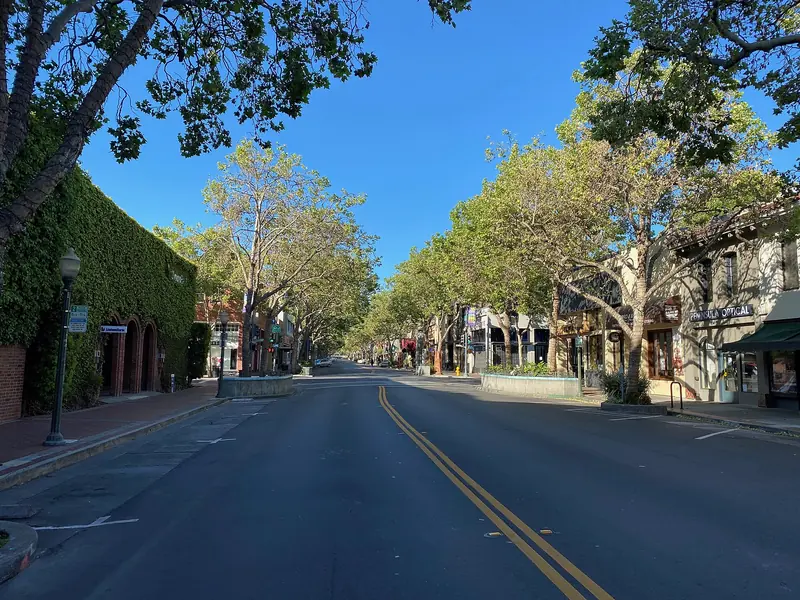

That makes Flipboard typical of many Palo Alto software companies today. Teams are spread out and offices are modest. The city still matters as a legal home, a meeting point and a place to hire. Our downtown guide and our page on University Avenue's tech history show how many companies have passed through the same few blocks.
Flipboard's place in the local ecosystem
Flipboard sits in a line of Palo Alto companies that tried to reshape how people get information. Google started downtown in 1999. Facebook launched its News Feed in 2006, during its Palo Alto years. Our Google and Facebook profiles cover those years. Flipboard took a different route, treating news more like a magazine than a list.
The city also has a long print tradition, from student papers at Stanford to local weeklies. Our history of Palo Alto's newspapers covers that side of the story.
Flipboard timeline
| Date | Event |
|---|---|
| Mid 2009 | Mike McCue retires from Microsoft after the Tellme sale and starts sketching the idea. |
| July 21, 2010 | Flipboard for iPad released. |
| December 2011 | iPhone version released. |
| June 2012 | Android version on Google Play. |
| March 2014 | Zite bought from CNN. |
| February 2015 | Web version launched. |
| July 2015 | $50 million from JPMorgan Chase. |
| February 2017 | Apps redesigned as version 4.0. |
| December 2023 | Fediverse integration begins. |
| December 2024 | Surf app launched. |
Visiting notes
Good to know
- Flipboard does not offer office visits or tours. The Bryant Street address is for mail and legal notices.
- For help with the app, use Flipboard's online help pages rather than the mailing address.
- If you want a good place to read the news in person, our guide to cafes for working lists downtown spots with seating.
For more companies with a Palo Alto chapter, see our companies hub.
Frequently asked questions
Where is Flipboard based?
Flipboard is based in Palo Alto. Its privacy policy, as posted in 2026, gives a legal mailing address of 555 Bryant Street #352, Palo Alto, CA 94301. Its terms say arbitration takes place in Palo Alto. Press coverage has described it as a Palo Alto company since its early years.
Who founded Flipboard?
Mike McCue and Evan Doll. McCue had co-founded the voice technology company Tellme Networks, which Microsoft bought in 2007. Doll was an Apple engineer who had worked on the early iPhone.
When did Flipboard launch?
Flipboard released its first app, for the iPad, on July 21, 2010, a few months after the iPad went on sale. iPhone, Android and web versions followed between 2011 and 2015.
Is Flipboard still around?
Yes. Flipboard still runs its app and website. In December 2023 it began connecting with the fediverse, the network of services such as Mastodon. In December 2024 it launched a separate app called Surf.
Can I visit Flipboard's office?
No. Flipboard does not offer tours or public visits. The address in its privacy policy is a mailing address for legal notices. Contact the company online instead.