On this page
Coursera is one of the largest online learning platforms in the world. Universities and companies publish courses, certificates and full degrees on it. Learners take many of them free and pay for credentials, graded work and degree programs. After combining with Udemy in 2026, the company says it reaches about 290 million learners.
It began as a Stanford experiment. In the fall of 2011 the School of Engineering offered three of its computer science courses online, free, to anyone. The response was far larger than anyone expected. Two of the professors involved, Andrew Ng and Daphne Koller, left to build a company around the idea. This profile uses Stanford Engineering's 2011 announcement, the company's own releases and reputable reporting.
Stanford's 2011 experiment
On August 15, 2011, Stanford Engineering announced three free online classes for the fall, run with the Stanford Center for Professional Development:
- Machine Learning, taught by Andrew Ng, then an associate professor of computer science.
- Introduction to Artificial Intelligence, taught by Sebastian Thrun and Peter Norvig of Google.
- Introduction to Databases, taught by Jennifer Widom, chair of the Computer Science Department.
The classes were set to start on October 10 and run through December. Even before launch, more than 58,000 people had signed up their interest in the AI course alone, according to Stanford. Reported enrollment eventually reached the hundreds of thousands across the three, with about 160,000 in the AI course.
The format had roots in Koller's own teaching. Stanford's announcement credits her with a January 2010 pilot that recorded lectures as short videos and used class time for problem solving. Short video segments with built-in quizzes became the standard pattern for online courses that followed.
Andrew Ng and Daphne Koller
Ng and Koller were both Stanford computer science professors with research in machine learning and artificial intelligence. After the fall 2011 courses, they left Stanford to launch Coursera in 2012. Thrun, from the AI course, took a parallel path and founded Udacity. The two companies grew from the same semester and the same department.
Both founders' academic work belongs to the long AI tradition at Stanford that runs back to John McCarthy's lab in the 1960s. Our page on Stanford and the history of AI traces it.
Launch and early growth
Coursera launched publicly in April 2012. Its first university partners were Princeton, Stanford, the University of Michigan and the University of Pennsylvania. Instead of building its own courses, Coursera hosted courses made by universities, which kept their names on the content. Coverage of the April launch noted that the catalog already reached beyond computer science, with humanities offerings such as poetry. In 2014 the site won both the Webby Award and the People's Voice award in the Webbys' education category.

The startup raised an initial $16 million from Kleiner Perkins and New Enterprise Associates, two firms with long Menlo Park roots. More rounds followed through the decade:
| Year | Round |
|---|---|
| 2012 | Initial $16 million from Kleiner Perkins and NEA |
| 2013 | Series B of $63 million, led by GSV |
| 2015 | Series C of more than $60 million, led by NEA |
| 2017 | Series D of $64 million from existing investors |
| 2019 | Series E of $103 million |
| 2020 | Series F of $130 million |
The year of the MOOC
Coursera arrived at the right moment. Massive open online courses, shortened to MOOCs, became one of the biggest stories in higher education in 2012. The New York Times called it "The Year of the MOOC" that November. Harvard and MIT launched their own nonprofit platform, edX, the same year. Udacity was already signing up students for its first classes.
Universities joined Coursera quickly because the arrangement cost them little and put their names in front of huge audiences. Learners joined because the courses came from famous schools and cost nothing. The hard questions came later: how many people finished, whether employers valued the certificates and who would pay for it all. Reports in 2020 suggested fewer than 10 percent of learners paid. The answers shaped the business model that followed.
How it makes money
The early promise was free courses for everyone. Coursera kept a free option but added paid layers over time. In 2013 it began selling verified certificates and said it had earned $1 million from them by September of that year. In 2016 it put graded assessments behind a fee in most courses that belong to multi-course Specializations, while offering financial aid to people who need it. The same year it launched Coursera for Business to sell training to employers. A government and nonprofit version followed in January 2017.
Today its catalog runs from single courses to Professional Certificates made with companies and full online degrees from universities. Jeff Maggioncalda became chief executive in June 2017. Greg Hart now holds the role.
Going public and joining Udemy
Coursera priced its initial public offering at $33 a share on March 31, 2021. It listed on the New York Stock Exchange under the ticker COUR. It describes itself as a Delaware public benefit corporation and a certified B Corp.
On December 17, 2025, Coursera announced a deal to combine with Udemy, the online course marketplace. Stockholders approved it on April 9, 2026. Coursera announced the deal was complete in May 2026. According to its release, former Coursera stockholders own about 59 percent of the combined company, which unites about 290 million learners, 18,000 enterprise customers and 95,000 instructors. Andrew Ng is chairman of the board.
Coursera timeline
| Date | Event |
|---|---|
| January 2010 | Koller pilots short video lectures at Stanford. |
| October 10, 2011 | Stanford's three free online courses begin. |
| 2012 | Ng and Koller found Coursera; public launch in April. |
| June 2017 | Jeff Maggioncalda becomes chief executive. |
| March 31, 2021 | IPO priced on the NYSE. |
| December 17, 2025 | Udemy combination announced. |
| May 2026 | Udemy combination completed. |
Coursera's place in the local story
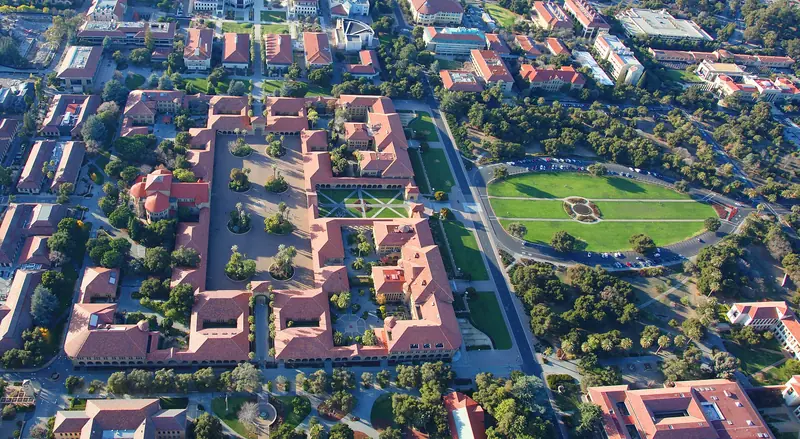
Coursera is a newer kind of Stanford spinout. It did not license a patent or a chip design. It took a teaching method that professors had tried in their own classes and turned it into a platform for other universities. Stanford became one of its first partners instead of its parent.
For Stanford, the experiment also changed teaching at home. Short recorded lectures and online quizzes, tested on huge public audiences, spread into many campus classes as well. The university now runs its own online programs, some of which appear on Coursera alongside courses from hundreds of other schools.
It also shows how the old network still works. A Stanford experiment drew attention, Sand Hill Road firms funded it within months and the company settled a few miles away in Mountain View. For more on how Stanford supports founders, see our guide to Stanford entrepreneurship programs.
Visiting notes
Good to know
- Coursera's Mountain View offices are private, with no tours or visitor center.
- To hear Stanford faculty in person, try the free talks listed on our public lectures page.
- Stanford Continuing Studies offers in-person and online classes for adults. See our Continuing Studies guide.
Frequently asked questions
Who founded Coursera?
Stanford computer science professors Andrew Ng and Daphne Koller founded Coursera in 2012. Both had experimented with putting Stanford courses online. Ng's free Machine Learning course in fall 2011 was one of the three that launched the idea.
Is Coursera part of Stanford?
No. Coursera is an independent public company. Stanford was one of its first four university partners in 2012, alongside Princeton, the University of Michigan and the University of Pennsylvania. Stanford courses are still offered on the platform.
Where is Coursera headquartered?
Coursera's press releases carry a Mountain View, California dateline. Its offices are private and do not offer tours.
Did Coursera merge with Udemy?
Yes. Coursera announced a deal to combine with Udemy on December 17, 2025. Stockholders approved it on April 9, 2026. Coursera announced the deal was complete in May 2026. Greg Hart is chief executive and Andrew Ng is chairman.
When did Coursera go public?
Coursera priced its initial public offering at $33 a share on March 31, 2021. It trades on the New York Stock Exchange under the ticker COUR.